Understanding Chronic Diseases and the Promise of Precision Preventive Medicine
José R. Rodríguez Alonso, M.D.¹; Guillermo De Angulo, M.D., FAAP¹; Ernesto Alonso, M.D.¹; Damian Cohen, M.D.¹; Damaris Rodríguez¹; Ana Cantillo-Rodríguez, RN¹
¹ For Better Health and a Better Future Foundation, Inc., Florida, USA.
Scientific and Educational Team – For Better Health and a Better Future Foundation, Inc.
What Does It Really Mean to Be Healthy?
When a baby is born, one of the first questions parents ask is simple:
Is my baby healthy?
When the answer is yes, families celebrate the beginning of a new life filled with hope and possibilities.
But this raises a deeper question:
Are we truly born healthy, or are we born with different levels of biological vulnerability that may influence our health throughout life?
A newborn may appear perfectly healthy, with normal growth, normal physical examinations, and no signs of disease. Yet the absence of visible illness does not necessarily mean the absence of future health risks.
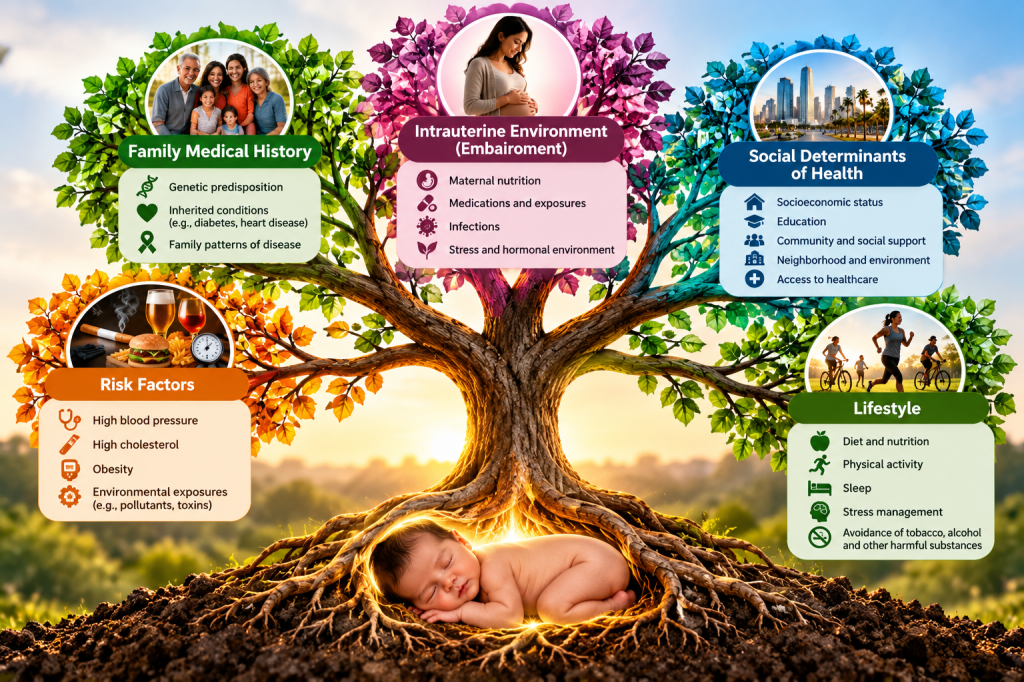
Our health is influenced by much more than what doctors can observe at birth. Genetics, conditions during pregnancy, environmental exposures, nutrition, and other biological and social factors can contribute to our future health [3,4].
Being healthy today does not guarantee that we will remain healthy tomorrow.
Understanding this distinction is one of the foundations of preventive medicine. It also opens the door to a more personalized and proactive approach to disease prevention: Precision Preventive Medicine.
Rather than assuming that everyone faces the same health risks, this approach seeks to consider individual differences in biology, genetics, lifestyle, environmental exposures, and social circumstances to guide more appropriate preventive strategies [5].
What Are Chronic Diseases?
Chronic diseases are health conditions that last one year or longer and require ongoing medical attention, limit daily activities, or both [1].
Some of the most important examples include:
- Cardiovascular diseases, including heart disease and stroke.
- Diabetes mellitus.
- Cancer.
- Chronic respiratory diseases, including asthma and chronic obstructive pulmonary disease (COPD).
- Chronic kidney disease.
- Other long-term conditions that may affect physical and mental well-being.
The World Health Organization identifies cardiovascular diseases, cancers, chronic respiratory diseases, and diabetes as four major groups of noncommunicable diseases [2].
Unlike many acute illnesses, chronic diseases often develop gradually. Some may progress for years before producing noticeable symptoms.
High blood pressure, for example, is a chronic health condition and a major risk factor for cardiovascular and kidney diseases. It may remain asymptomatic for years.
Waiting for symptoms before taking action may mean missing valuable opportunities for prevention.
According to the Centers for Disease Control and Prevention (CDC), approximately three out of four American adults live with at least one chronic condition, and more than half have two or more [1].
These conditions represent an enormous burden for individuals, families, communities, and healthcare systems [1,2].
When Does the Risk of Chronic Disease Begin?
For many years, chronic diseases were commonly associated with aging. Today, scientific research offers a broader perspective.
The risk of developing certain chronic diseases may begin to take shape much earlier in life, sometimes during fetal development or childhood.
Research into the Developmental Origins of Health and Disease (DOHaD) suggests that harmful exposures during critical periods of early development may increase the risk of certain diseases later in life. Conditions under investigation include obesity, type 2 diabetes, cardiovascular disease, asthma, and some cancers [3].
This does not mean that a child is destined to develop a particular disease.
Rather, health develops through complex interactions among inherited characteristics, biological processes, environmental conditions, and experiences throughout life [3,4].
Genes may influence our susceptibility to disease, but they do not always determine our future.
The National Institute of Environmental Health Sciences (NIEHS) emphasizes that many complex diseases arise through interactions between genetic characteristics and environmental influences [4].
Understanding these relationships may help researchers identify opportunities for earlier and more targeted prevention.
Can Chronic Diseases Be Prevented?
Not all chronic diseases can be prevented. Some are strongly influenced by genetic factors, while others have causes that are not fully understood.
However, many chronic disease risks can be reduced through evidence-based public health measures, healthier environments, preventive healthcare, and early detection [1,2].
Important strategies include:
- Eating a balanced and nutritious diet.
- Engaging in regular physical activity.
- Avoiding tobacco and exposure to secondhand smoke.
- Limiting harmful alcohol consumption.
- Monitoring important health indicators, such as blood pressure and blood glucose, when appropriate.
- Receiving recommended vaccinations, screenings, and preventive medical care.
These strategies address several major behavioral and metabolic risk factors identified by the CDC and WHO [1,2].
But prevention is not simply about telling people to make better choices. Healthy choices are also influenced by access to nutritious food, safe neighborhoods, education, affordable healthcare, and supportive communities [1,2].
Effective prevention therefore requires both individual participation and collective responsibility.
This is also where Precision Preventive Medicine may offer additional opportunities.
Traditional preventive recommendations are often designed for broad populations. Precision-based approaches seek to complement these recommendations by considering differences in individual and population risk.
For example, two people of the same age may have different family histories, environmental exposures, metabolic characteristics, and healthcare needs.
Understanding these differences may help healthcare professionals recommend more appropriate preventive measures [5].
Precision prevention does not mean that everyone needs genetic testing or expensive technology. It means using reliable, relevant information to make prevention more appropriate, equitable, and effective.
Why Should Prevention Begin with Adolescents and Families?
Adolescence offers an important opportunity for health education and the development of healthier habits. During these years, young people can acquire knowledge about nutrition, physical activity, tobacco exposure, and other factors associated with chronic disease risk [1,2].
Imagine a teenager learning about the relationship between nutrition, physical activity, blood pressure, and diabetes.
That student may begin asking questions at home:
- Why do we eat the foods we eat?
- How much physical activity does our family get?
- When was the last time our grandparents had their blood pressure checked?
- And perhaps most importantly: Which chronic diseases have affected our parents, grandparents, and other close relatives?
A simple educational experience can create opportunities for meaningful conversations across generations.
Learning about family health history may also help families and healthcare professionals recognize patterns of disease and identify potential risk factors. However, family history is only one component of a comprehensive health risk assessment.
We believe that adolescents can become important participants in building a culture of prevention within their families and communities.
This belief is central to our Foundation’s proposed community prevention initiatives.
Our approach seeks to combine health education, community engagement, scientific research, and preventive interventions while exploring how individual and family risk factors may inform future precision-based strategies.
These are programmatic goals that require evaluation. We do not assume that every proposed intervention will produce measurable health benefits without scientific assessment.
Our goal is not to make young people responsible for their relatives’ health. It is to provide families with knowledge, resources, and opportunities to make informed decisions together.
From Reactive Healthcare to Proactive Precision Preventive Medicine
Modern medicine has achieved extraordinary advances in diagnosis, treatment, surgery, pharmaceuticals, and medical technology. These achievements save lives every day.
Yet preventing chronic diseases also requires attention to risk factors before illness develops, alongside screening, early diagnosis, effective treatment, and ongoing care [1,2].
Preventive medicine asks an additional question:
- What can we do today to reduce the likelihood of disease tomorrow?
Precision medicine adds another dimension:
- How can we use individual and population characteristics to make preventive strategies more appropriate for those who need them? [5]
Together, these questions point toward a proactive, precision-based approach to prevention.
Treatment and prevention are not competing approaches. They are complementary responsibilities of an effective healthcare system.
The scientific foundations, opportunities, and challenges of Proactive Precision Preventive Medicine deserve a more detailed discussion, which we will explore in a future article.
Our Commitment: Building a Culture of Prevention
At For Better Health and a Better Future Foundation, Inc., we believe that building a healthier future begins with education, scientific evidence, community engagement, and preventive action.
Our mission is to advance chronic disease prevention through health education, scientific research, community health promotion, and preventive healthcare initiatives.
We envision a future in which Precision Preventive Medicine becomes an increasingly important component of community healthcare.
Through our proposed initiatives, we seek to develop and evaluate proactive, evidence-based approaches that help adolescents and families understand health risks, strengthen health literacy, and make informed decisions.
Our goal is to contribute to a culture in which prevention begins early, continues throughout life, and reflects the needs of individuals, families, and communities.
A Final Question
So, are we really born healthy?
In many cases, we are born without detectable disease. But we are also born with individual biological characteristics and into environments that can influence our health over time [3,4].
Our future health is neither entirely predetermined nor entirely under our personal control.
It is shaped by biology, circumstances, healthcare, and opportunities for prevention throughout life.
Perhaps the most important question is not only whether we are born healthy.
It is what we can do, individually and together, to remain healthier throughout our lives.
Prevention begins with knowledge. A healthier future begins with action.
For Better Health and a Better Future.
References
[1] Centers for Disease Control and Prevention (CDC). About Chronic Diseases. Updated May 14, 2026.
https://www.cdc.gov/chronic-disease/about/
[2] World Health Organization (WHO). Noncommunicable Diseases. September 25, 2025.
https://www.who.int/news-room/fact-sheets/detail/noncommunicable-diseases
[3] National Institute of Environmental Health Sciences (NIEHS), National Institutes of Health. Developmental Origins of Health and Disease. Last reviewed January 5, 2026.
https://www.niehs.nih.gov/research/supported/health/developmental
[4] National Institute of Environmental Health Sciences (NIEHS), National Institutes of Health. Gene and Environment Interaction.
https://www.niehs.nih.gov/health/topics/science/gene-env
[5] National Institutes of Health (NIH). The Promise of Precision Medicine.
https://www.nih.gov/about-nih/nih-turning-discovery-into-health/promise-precision-medicine
Educational disclaimer: This article provides general health information and does not replace individualized medical advice, diagnosis, or treatment.

